Production Planning & Execution
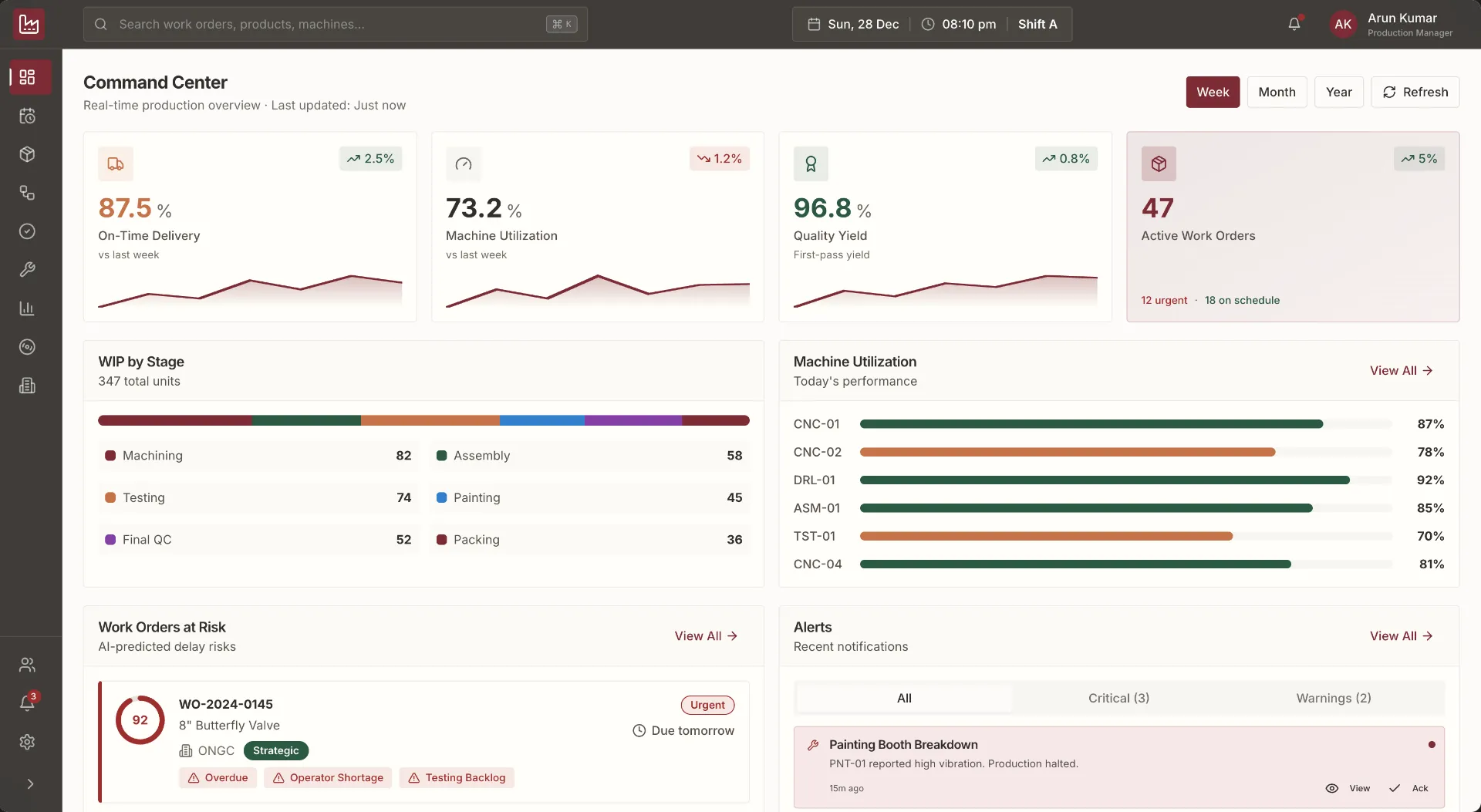
A unified, real-time production command center that replaces spreadsheet-based planning with machine-connected, AI-assisted scheduling, execution tracking, and operational visibility across the factory floor.
Partnership Goal
→ Build a unified, machine-connected production planning and execution system to replace fragmented spreadsheet-based processes and provide real-time visibility into schedules, WIP, capacity, and operational risks across the manufacturing operation.
Service
Custom Web Application
Overview
An AI-enabled production planning and execution system built for an industrial valve manufacturer, integrating directly with CNC machines, PLCs, and the company's ERP. Deployed on a private AWS cloud, the system replaced spreadsheet-driven planning with real-time, constraint-aware scheduling, live shop-floor visibility, and predictive operational intelligence.
Scope:
Challenge
Production planning and execution relied on spreadsheets and disconnected tools. Schedules did not reflect real machine availability, setup losses, material readiness, or maintenance conditions. WIP status was often outdated, quality issues were detected late, and machine breakdowns disrupted delivery commitments. Leadership lacked a single, real-time view of capacity, bottlenecks, and operational risk.
Schedules did not reflect real machine availability or setup losses
WIP status was often outdated and inaccurate
Quality issues were detected late in the process
Machine breakdowns disrupted delivery commitments
No single, real-time view of capacity and bottlenecks
Leadership lacked visibility into operational risk drivers
Solution
We implemented an AI-assisted APS and MES layer integrated with CNC machines, PLCs, and ERP, operating as a live operational control system. The planning engine optimizes production sequences using real-time machine states, actual cycle times, setup durations, tooling availability, material readiness, historical downtime patterns, and quality performance. Schedules are continuously re-optimized when machines go down, priorities change, or risks emerge.
• Constraint-aware, AI-assisted production scheduling • Real-time WIP and order progress tracking from machine signals and operator inputs • Material forecasting aligned to actual consumption and supplier performance • AI-assisted quality monitoring using inspection and defect history • Condition-based and predictive maintenance using CNC alarms and performance trends • Role-based dashboards for planners, supervisors, maintenance, and leadership
Process
Team
- 1 Product Manager
- 2 Senior Full-Stack Developers
- 1 Data Engineer
- 1 IoT Specialist
- 1 UX Designer
Technology Stack
Frontend
Backend
Infrastructure
IoT & Data
Deep Domain Modeling
Mapping of routing, constraints, setups, and failure patterns with production teams.
UX & Decision-Centric Design
Design of real-time, decision-centric user experiences for planners and supervisors.
Event-Driven Architecture
Architecture of an event-driven system integrating ERP, machine data, and analytics.
Incremental Rollout & Validation
Incremental rollout with validation against live production scenarios.
Continuous Optimization
Continuous optimization of planning and prediction models post-go-live.
1 / 7 - Click to view fullscreen
Outcome
The system transformed planning and execution from static, spreadsheet-based control to a live, machine-connected operational command layer.
Production schedules became feasible, adaptive, and quickly re-optimizable
Real-time visibility into WIP, machine utilization, and bottlenecks eliminated blind spots
Maintenance shifted from reactive breakdown handling to condition-based planning
Quality risks were detected earlier in the process, reducing rework and delivery uncertainty
Management gained a single, trusted view of throughput, capacity, and operational risk drivers
Related Case Studies
Looking for something similar?
Let's discuss how we can help you achieve similar results for your business.